

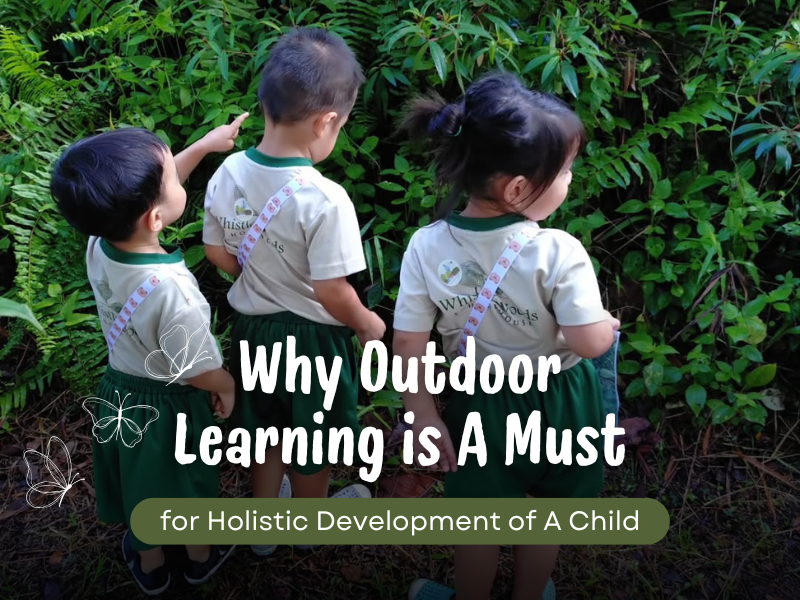
Most parents think of outdoor time as part of the school day, when children take a break from learning. However, teachers see it differently. What happens outside, particularly in an unstructured or semi-structured setting, asks something of a child that a classroom rarely can. The feeling of oneness with Nature for the children transports them into a happy zone where they learn, unlearn and grow in their own rhythm. Whistle Woods Schoolhouse, the best Montessori preschool in Singapore, prioritises the need for outdoor time for children. The mind and body of the little ones get involved holistically when they engage in a wide range of outdoor activities.
When outdoors, children decide what to attempt
When children step outside, they become the authors of their own adventures. Exploring greenery does more than teach them about plants, fruits, and vegetables. It gives them the freedom to make choices, navigate the unexpected, and connect deeply with their peers in the natural world.
To an outside observer, children might just look like they are wandering around. However, every movement has meaning, turning a simple walk into a learning journey that supports the goals of a modern preschool curriculum in Singapore.
Some of what we observe children attempting during walks and outdoor time:
- Stepping across uneven ground and working out where to place their feet
- Picking up and carrying something heavy, then adjusting when it gets too much
- Crouching to look at something small, then eagerly sharing that discovery with another friend
- Responding to rain, wind, or an unfamiliar sound with curiosity rather than alarm
A child working through any of these situations is solving something real, with no adult having prepared the answer. You observe how children carry themselves, a willingness to try something before looking around for permission.
Outdoor settings change how children are with each other
When children move through an outdoor space together, the social dynamics shift in ways teachers find worth paying attention to.
Indoors, the adult tends to organise the group. Outside, children sort themselves out. Who calls others over to see something, who holds back, who takes a younger child’s hand on a slippery patch… all this happens without prompting, which is part of the unique boutique preschool advantage that encourages independence and social growth.
In a mixed-age group, outdoor time tends to bring out a natural protectiveness in older children toward younger ones.
We see this reliably on our walks near Bukit Timah, where the older children often take on a quiet responsibility without being asked. For younger children, watching this and being included in it teaches them what it means to be part of a group.
A child who has moved hard outside often settles better indoors
Teachers observe this as a daily pattern rather than a frequent occurrence.
A child who has walked, carried, climbed, or run often comes back to the classroom ready to sit with something quieter.
The restlessness that makes the focus on indoor work difficult for some children often eases after they spend time outdoors.
What we have seen over time
During walks, there’s something teachers notice keenly over a full term. Children who spent the first weeks hanging back gradually become the ones leading the group toward whatever is ahead.
We head outdoors as per our Waldorf-Montessori curriculum, wet or dry, with all-weather gear kept at school. Get in touch to know more about what a typical day here looks like.
Also Read: How Food and Mealtime Connect Children in a Preschool?