

Your child’s first school stays with them longer than you expect.
The handover at the gate feels routine after a while. Inside, something else happens. Your child learns how long he will take to adapt. How it feels to wait, to try, to pause.
That weight sneaks up on you when you start choosing a preschool. As a parent, you will have a huge task in hand. Choose the best preschool that focuses on holistic learning and overall development of a child by deftly incorporating Waldorf-Montessori educational methodologies in their curriculum.
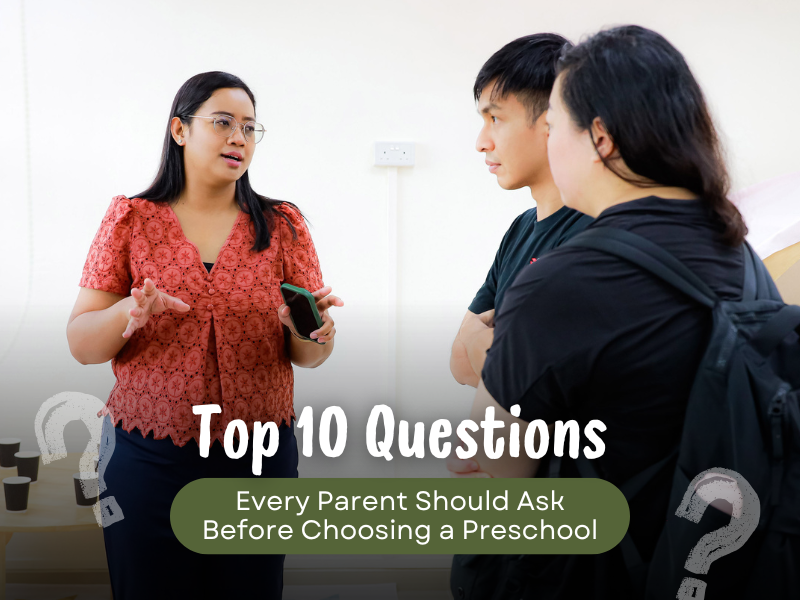
Here are 10 questions worth sitting with before you decide.
1. What kind of day does a child spend before coming home?
Some schools are packed with scheduled activities. Others leave room for drift and unstructured discovery.
Picture your child at different time intervals when he is at school.
Does he feel held, charged up or overstimulated?
When you put your children in a Waldorf-Montessori setting of a top-rated preschool in Singapore, they grow and learn at their own pace amidst nature in a completely tech-free environment.
2. How do you approach conflict between children?
Watch how the teacher explains this!
Do they step in immediately, or give children space to navigate it?
A Waldorf-Montessori blend, for instance, often encourages peaceful observation before adult intervention happens. As long as there is no physical danger to anyone, a teacher lets children understand feelings first, before guiding the children in a calm, respectful way. Gradually, children learn how to respond to conflicts through positive role modelling.
3. How do your teachers stay grounded in the work?
Children understand and identify emotions more than instructions.
A teacher must pass on that warm energy. In a Waldorf–Montessori setting, grounding starts with the teacher. The calmness and empathy that a teacher showcases naturally fills the air inside the classroom. It helps in shaping a child’s journey as a human being.
Ask if teachers have prep time, regular mentorship, or even quiet pauses in their day. The answer will tell you what kind of educator your child will learn from.
4. What does “free play” actually look like here?
Some preschools label 15-minute toy breaks as playtime.
In a more nature-rooted preschool in Bukit Timah, children might spend half a morning playing and exploring outdoors (chasing each other, skipping ropes, blowing bubbles, relaxing on a mat etc).
Ask for photos, or even better, visit yourself before deciding on a preschool.
5. How do you create a calm atmosphere without using rewards or raised voices?
Children don’t need silence, but they need safety.
Ask how teachers guide the energy of the room, especially when things get noisy or unsettled.
Do they use songs or storytelling?
In a preschool that runs on Waldorf-Montessori blended methods, the tone of voice and pace of movement carry more weight than instructions.
The way calm is held tells you what your child will learn about regulation.
6. Where do you say no and why?
Children feel safer when boundaries are clear and kind.
In many Waldorf-Montessori classrooms, children have freedom to move and explore, but also meet firm expectations, like when meals begin, how materials are handled, or how transitions unfold.
Ask what rules the school follows, and more importantly, how they help children understand and trust those limits.
7. What happens when a child resists?
Your child might refuse to put on shoes. Or cry for hours. Or throw a toy.
How does the school hold space for that without shame?
The tone in their answer reveals everything.
8. How is the daily structure balanced between guidance and freedom?
Too much control can feel rigid. Too much choice can feel unsteady.
The Montessori preschools in Singapore that swear by Waldorf-Montessori blended methods often hold a gentle structure (with fixed moments like snack time or circle time) while still leaving space for unhurried exploration.
Ask what a typical day includes, then ask how teachers adapt when a child needs more time or less direction.
9. How do you help children transition, not just settle?
Settling is short-term. It is just about getting them to stop crying. Transitioning is deeper. It is about creating a sense of safety for them, so that they can play well, learn well and nap well.
Morning songs, familiar scents, favourite fruits, or a comfort object from home can help your child feel safe, not simply distracted.
10. What would other parents say?
Skip self-testimonials and look for real connections.
Attend a school event and speak with parents whose children are currently enrolled. Ask about their experiences, and how their children feel about school. You can also check Google reviews and social media stories to get a sense of the community, values, and everyday experiences shared by families.
Final thoughts
Most days, your child won’t remember what they were taught. But they might remember how they felt. Whether someone waited for them to finish. Whether they had time to watch the rain before lunch.
That’s the kind of care we try to hold in our Waldorf-Montessori classrooms. It shows up in small ways, like how a teacher lowers their voice instead of raising it.
If you’re looking at preschools in Bukit Timah (especially those with a nature-rooted or Waldorf-Montessori approach), maybe begin with this. What does the space feel like?