

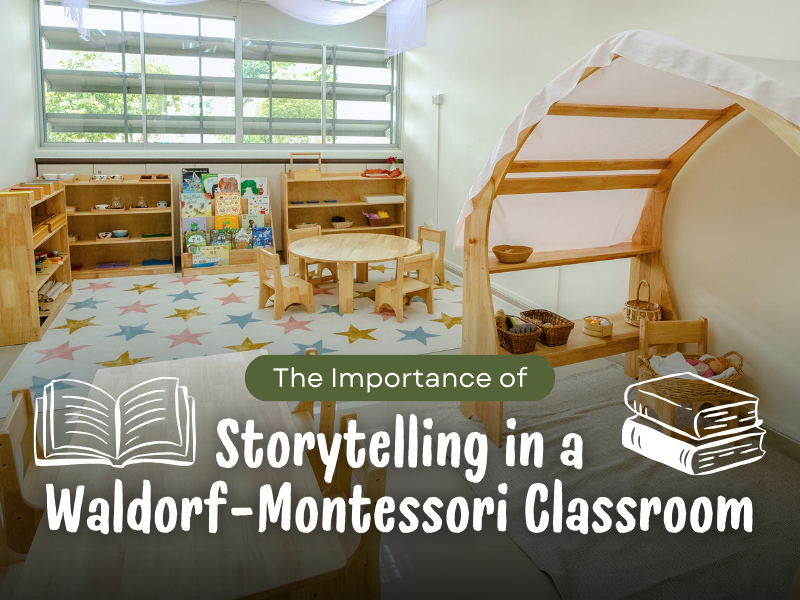
One child leans forward on the rug, whispering to a friend about whether the bear will ever find the honey. Another stays near the edge, listening while they hold a small figure – such scenes are common in cosy classrooms of a boutique preschool in Singapore, often found in places known for the best Montessori preschool in Singapore.
When a story begins, the room grows still. Some children lean closer, eager for what comes next, while others listen quietly, letting the images unfold in their minds. This is one of the simple ways how preschool makes children feel confident, as they become comfortable sharing ideas and listening to others.
In these shared moments of imagination, each child finds their own way into the story. And little by little, the classroom becomes a place where listening deepens, friendships grow, and a common rhythm gently carries the day forward. These are some of the quiet reasons parents are choosing boutique preschool environments for their children.
Storytelling supports smooth transitions
Stories help create a gentle rhythm in the classroom. As children listen, they follow the unfolding sequence — first this happens, then something else follows. This sense of order makes it easier for them to move from one activity to the next, something many families notice in a nurturing Bukit Timah preschool setting.
In a Waldorf-Montessori classroom, a short story narrated when children arrive can flow into handwashing, snack preparation or maybe during some cleaning work at the shelves. Children often carry that order into action, which is also part of the 7 Social Skills Kids Develop in Preschool through daily interactions and routines.
Through storytelling, children experience that events unfold step by step. Just like the bear who searches, waits, and eventually finds the honey, they begin to understand that each moment leads to the next.
Over time, this sense of rhythm and order can support smoother routines beyond the classroom as well.
Stories help children name feelings and make repairs
Emotional language grows when children meet feelings through a character, then link them to real moments with friends. This approach is often seen in thoughtfully designed Montessori preschools in Singapore.
A teacher may linger her tone while narrating the portions where the bear waits, feels disappointed, then tries again, since those scenes match everyday classroom life.
Tone changes and gestures carry meaning. Your child learns how to care for sounds and make meaning of the words they get glued to.
Later, story phrases often appear during play when children work through a disagreement and return to the game.
Verbal storytelling strengthens language through responsiveness
Storytelling builds language as children try and absorb what they listen to. The teacher adjusts pace and emphasis so that children can comprehend better. A pause gives time for meaning to grip the mind of the little ones. Repeated lines not only hammer in the minds of the children – they can carry a sentence, a phrase or a new word in their mind which they use later during play or at snack time, reflecting the thoughtful preschool curriculum in Singapore.
Many classrooms revisit the same story over a few days or weeks, keeping the core events familiar while sharpening one detail each time, such as a key verb or a feeling word.
Children often retell it in play, which strengthens vocabulary and sequencing.
Stories carry into hands-on work
Hands-on follow-through helps attention hold because your child can carry the story into something they do with their hands.
A story about preparing food can link to pouring water and setting a table with care, and the bear’s careful steps can become the child’s careful steps. A story about caring for a space can connect to polishing wood or arranging flowers, where order becomes visible on the table.
Your child hears the words, then practises them through real steps during the work cycle.
Stories support belonging in mixed-age groups
Belonging in mixed-age groups often starts with shared material that children can return to together. You may see:
- Younger children join through rhythm and a repeated line
- Older children hold the sequence and suggest roles in play
- Children with fewer words take part through gesture, then add language later
- A familiar phrase becomes an easy invitation into a game
Final Thoughts
Storytelling provides a holistic learning experience for the children. It shows up beyond the ordinary. It has a calming effect in shaping the minds of the little ones in the way children choose work, speak to friends, and organise their play.
Our Waldorf-Montessori approach keeps stories close to daily life so that young minds can relate and connect to things easily. We engage them in practical work, offer sensory materials, music, movement, and time outdoors, so your child can learn from the narratives and make a good use of their learning experience while making real choices.
In our Bukit Timah classroom at Whistle Woods Schoolhouse, a story often leads into baking, painting, building, or a focused table activity. The narration has a great impact in the lives of the children. They enjoy carrying it forward during playtime with genuine clarity. If you want to learn more, get in touch with our team today.