

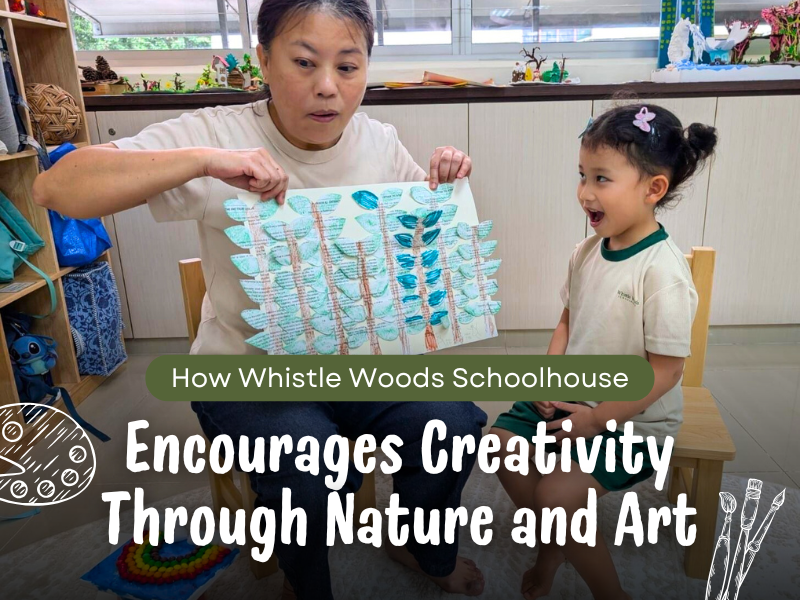
Children create more freely when their environment invites them to.
That doesn’t happen through pressure. It happens through rhythm, space, and the quiet permission to try.
At our schoolhouse, we see this every day in a paint-streaked apron, a handmade crown, a song hummed during snack time.
This isn’t performance. It’s real expression.
Here’s how we keep that expression alive and growing.
Children create more when they feel unhurried
Time affects creativity.
When children are rushed, their ideas shrink.
That’s why our routines follow a slower rhythm. We don’t crowd the day with transitions. Instead, we allow time to return to unfinished work or build on what sparked interest yesterday.
You might see a child return to the same stick house for three mornings straight, adjusting it one stone at a time. Or hear a story evolve across an entire week, shaped by a child’s own unfolding logic.
This spaciousness gives ideas room to breathe. Children begin to trust that their voice has time here.
Natural materials shift how children approach art
What a child holds in their hands affects how they think.
When materials feel real (warm wood, soft wool, river stones), their response changes.
We keep the tools open-ended.
A silk cloth might become a stream, a curtain, or part of a puppet. Beeswax crayons blend differently than plastic ones, inviting more layering and depth.
There’s no single outcome expected. The material itself sparks thought.
This is part of what draws families seeking a Waldorf Montessori preschool in Singapore—schools where the process carries more meaning than the final product.
Nature becomes the starting point for most creative work
Art often begins outside.
The children gather fallen seed pods, press leaves into clay, and mix mud for pretend recipes.
On our walks through the nearby Bukit Timah Reserve, they start noticing the colors of bark or the shape of clouds. Later, those images show up in their drawings or sand sculptures.
Instead of learning about seasons from a chart, they feel it shift in their own steps. That physical link to the world shows up in their creative choices, with no need for adult correction or prompting.
Nature doesn’t just influence their ideas. It forms part of their artistic language.
Art and nature are woven into daily routines
We don’t separate creative work into a special time slot.
It runs through the whole day in small, quiet ways.
- Children knead bread dough and shape their own buns
- Story time often includes simple finger puppets or illustrations made by the class
- Music flows into transitions, sung softly as we tidy or wash hands
- Painting and drawing stay available without waiting for “art time”
- Nature items gathered outdoors become part of the playroom
These activities feel natural because they come without pressure. The focus stays on the doing, not the result.
Expression grows stronger when children feel safe
Creativity rests on trust. Children create more freely when they feel seen.
This is why we keep the group sizes small and the relationships steady.
A child who feels understood will risk trying something new.
That might look like singing for the first time in front of peers, or adding their own twist to a group project. It’s subtle, but it builds over time.
For families looking for the best daycare in Singapore that blends emotional security with creative learning, this balance tends to stand out.
Final Thoughts
Creativity doesn’t require elaborate projects or special talent. It asks for care, presence, and the right kind of environment.
We shape our days around that idea.
Children at our schoolhouse spend time outdoors. They use tools made from real materials. They hear stories told with warmth, and songs that linger in the air long after circle time ends.
Art and nature stay within reach, not as activities, but as part of how we live together.
This kind of setting doesn’t push creativity. It simply makes space for it to appear, again and again.