

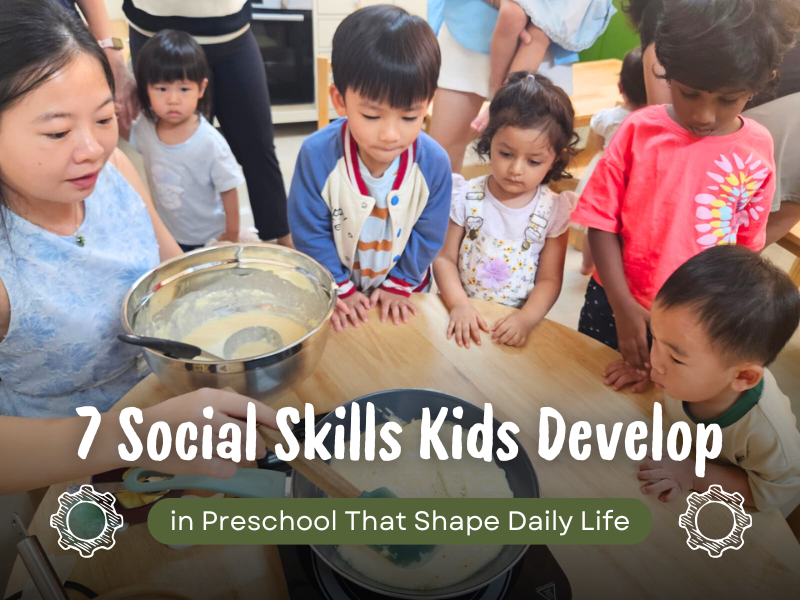
Children watch everything.
How adults greet each other. When someone waits their turn. What happens when two kids want the same toy.
They pick up more than we often realise. And in a well-known Waldorf Montessori preschool in Singapore, those lessons start becoming habits.
Let’s look at a few of the social skills that form early and continue to shape how your child moves through the world.
Learning how to take turns helps build patience
Taking turns sounds simple until you watch a group of preschoolers work it out.
One child reaches for the shovel. Another already holds it. They both pause, unsure who gets to decide.
In a well-held classroom, these moments are not rushed. The teacher stays close but lets the children try.
They may talk. They may wait. Sometimes, one simply steps back. That choice (waiting for something you want) builds patience in ways few lessons can teach.
When it is a Waldorf Montessori preschool Singapore, the virtue of patience is instilled in the minds of the children through structure and purpose. The Waldorf principle nurtures patience via rhythm and emotional warmth. This way, patience becomes a life skill that helps in enjoying the journey of life.
Naming emotions teaches children to self-regulate
A child who can say “I feel mad” or “I feel left out” already has tools many adults are still building.
Preschool settings help make emotions visible. A blended Waldorf-Montessori approach helps children to ace in naming emotions.
Books, songs, role-play, and gentle guidance turn tricky feelings into something they can speak.
This gives children a chance to respond, rather than react. With time, they begin to pause before pushing, to speak before crying.
You’ll likely hear these same phrases used at home, too.
Listening in a group builds awareness
Children in preschool learn to hold their voice while someone else speaks. You must choose a reputed Waldorf Montessori preschool near Holland village to make your child a good listener.
This can feel hard at first, especially when excitement takes over. But over time, they begin to notice group cues, including raised hands, shared silence, a quiet signal from a teacher.
These early group habits lay the groundwork for more than classroom behaviour. They help a child hold space for others in conversations, projects, and play.
These habits are often strong indicators in children attending a recommended preschool in Singapore with a Waldorf-Montessori approach. Parents trust such preschools for balanced development of their child.
Sharing without pressure encourages generosity
Preschool creates many shared spaces. Blocks, books, easels, snack tables.
Children begin to learn what it feels like to share. Not because they are forced, but because the classroom makes room for it. As per the Waldorf-Montessori principle, sharing is never forced or demanded.
The key lies in choice. When sharing feels expected but not demanded, it turns into a generous act rather than a forced one.
Children begin to notice when others need something, and often respond on their own. How they feel secure within themselves and how their emotional make-up develops contribute to making them kind humans in the long run.
Children are guided to share when they are ready—through example, rhythm, and meaningful social interaction.
Conflict resolution starts with simple phrases
Preschoolers disagree often.
One child builds a tower. Another knocks it over. In these moments, adults often want to jump in, but slowing down matters more.
Teachers may guide children toward simple, clear language: “I don’t like that.” “I was using that.” “Let’s build together.”
These phrases become tools children begin to carry forward—into home life, playdates, and eventually, school.
In a Waldorf-Montessori environment, conflict among children is seen as a natural part when it comes to social learning. Children are gently guided so that they don’t engage in tiffs, resolve disagreements in an empathetic way.
You may notice the shift when your child begins resolving little conflicts on their own.
Teamwork emerges through unplanned collaboration
Children working side by side often start helping each other without instruction.
One pours while another stirs. Someone fetches more paper without being asked. These moments often go unnoticed but carry weight.
This kind of teamwork grows best in calm, open classrooms where time is left unfilled on purpose.
It invites children to coordinate, respond, and assist. These are skills that carry far beyond the early years.
This quality is often seen in the best nursery schools in Singapore following the blended Waldorf-Montessori approach, where open-ended work is part of the daily rhythm.
Self-advocacy builds when children feel heard
In a Waldorf-Montessori environment, self-advocacy is regarded as the child’s growing ability to express their feelings and needs with confidence. It is not about speaking loudly or insisting on one’s way—it is about knowing one’s voice matters.
Children who feel safe speaking up, tend to keep doing so.
They ask for help. They say when they feel ready. They tell you what they need instead of shutting down.
This doesn’t happen through rules. It grows through response. When adults listen and adjust, children begin to trust their voice.
That trust becomes part of their identity.
Final Thoughts
A top-rated Waldorf Montessori preschool Singapore gives children a place to practice how to be with others.
Not through lessons, but through real moments, including disagreements, group projects, waiting for a snack, or offering help without being told.
In our boutique Waldorf-Montessori preschool Singapore, we pay close attention to these small social shifts.
We give time for children to speak, to feel, to negotiate. We let them lead when possible, and we guide gently when needed. That’s how confidence, kindness, and clarity take root.
Because what a child learns about others in these early years becomes part of how they carry themselves in every space after.