

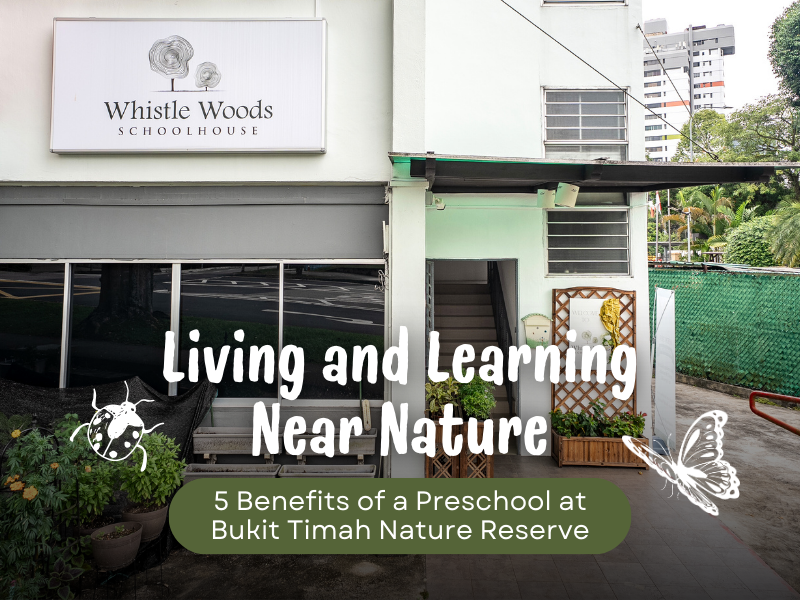
Children often behave differently when they become familiar with their environment. At Bukit Timah, this becomes noticeable quite quickly, especially in a Bukit Timah preschool where nature is part of the everyday setting.
One child might stop to check a spot where mushrooms appeared the week before. Another may climb the same low branch each morning before joining the group. These repeated interactions show that children are not just reacting to something new — they are remembering their surroundings and growing more comfortable in them.
A preschool located close to nature doesn’t need to create constant novelty. The environment itself changes gradually, and children learn to respond to those changes over time.
Here are some of the shifts we commonly observe when a preschool is situated near a nature reserve.
1. Children Learn to Adapt While Feeling Secure
When a familiar path is blocked, some children pause while others look for alternatives. With time, they begin suggesting solutions themselves, for example, taking a longer route or going around an obstacle. In a thoughtfully designed preschool curriculum in Singapore, these everyday moments are seen as valuable learning opportunities rather than interruptions.
These small adjustments build confidence and flexibility. Because the environment remains largely familiar, children can adapt without feeling unsettled. They learn that change can happen without losing their sense of security.
2. Natural Boundaries Encourage Self-Regulation
Outdoor environments often provide natural cues for behaviour. Children slow down on uneven ground, wait their turn to cross a log, or become more cautious when they see potential risks.
Instead of relying solely on verbal reminders or posted rules, children learn through direct experience. This type of learning often supports better awareness, responsibility, and confidence over time.
3. Real Environments Support Sustained Focus
Sometimes planned activities take a different direction outdoors. A child might choose to examine leaves instead of working with prepared materials, leading to questions about texture, shape, or change, moments that often reflect what is the role of teacher at Waldorf preschool in Singapore, where guidance follows the child’s curiosity rather than controlling it.
This can result in extended periods of focused observation without external prompting. The environment encourages curiosity naturally, and attention tends to build from genuine interest rather than structured instruction alone.
4. Social Dynamics Often Balance Out Outdoors
Outdoor environments often provide natural cues for behaviour. Children slow down on uneven ground, wait their turn to cross a log, or become more cautious when they see potential risks, something many parents reflect on when considering how to choose the right Montessori nursery in Singapore.
Instead of relying solely on verbal reminders or posted rules, children learn through direct experience. This type of learning often supports better awareness, responsibility, and confidence over time.
5. Familiar Natural Spaces Provide Stability
Regular exposure to the same outdoor spaces creates informal routines. Children may associate certain landmarks with specific activities, such as snack breaks or transitions in the day.
These consistent reference points help children feel secure while still allowing flexibility. The environment offers continuity without requiring rigid schedules.
Final Thoughts
At our Waldorf-Montessori preschool near Bukit Timah, nature is part of everyday learning rather than an occasional addition. As a Montessori nursery in Singapore, it influences how we plan activities, observe children, and support their development.
The natural setting provides both familiarity and gradual change, which helps children feel secure while encouraging growth. For families considering an early childhood programme near Bukit Timah Nature Reserve, a nature-integrated environment can offer a calm, balanced start to learning.
If you would like to learn more about how our programme works, we welcome you to get in touch or arrange a visit.