

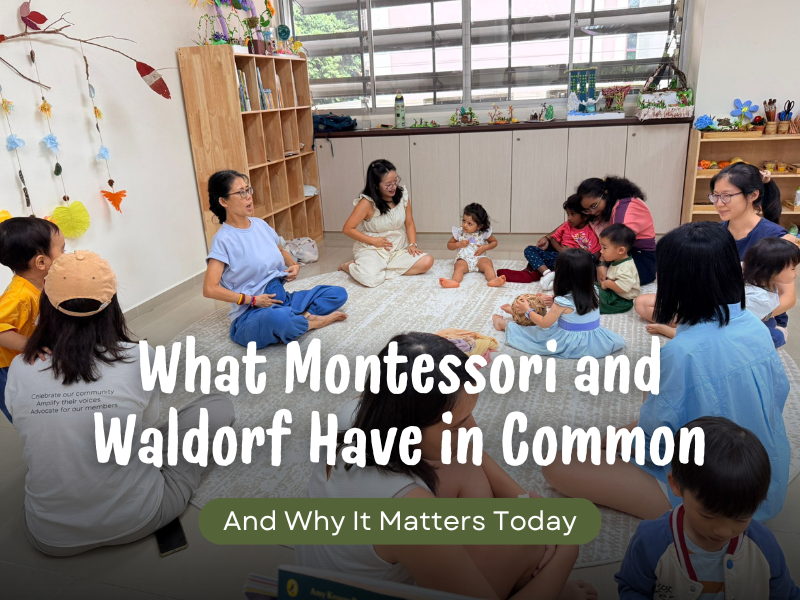
Montessori and Waldorf are two well-known approaches in early childhood education, more so in the West than in Asia. Both have European roots. Both were founded in the turbulent years marked by rapid industrialisation, war and great social change. The first Montessori school opened in Italy in 1907, followed by the first Waldorf school in Germany in 1919. While they emerged from different philosophical traditions, both arose from a shared concern about traditional schooling and a deep desire to honour childhood as a meaningful stage of life. More than a century later, these philosophies remain surprisingly relevant.
At the heart of both Montessori and Waldorf education is a deep respect for the child as a whole person. Children are not viewed as empty vessels to be filled with information, but as individuals with their own pace, interests, and inner lives. Learning is guided by developmental readiness rather than pressure, comparison, or early academic acceleration. Both approaches aim to nurture social, emotional, physical, and moral development alongside cognitive growth, recognising that education shapes who a child becomes, not just what they know.
In both Montessori and Waldorf classrooms, children learn by doing. Hands-on materials, real-life tasks, and purposeful activities replace worksheets and rote memorisation, allowing children to actively construct understanding through experience. In Montessori environments, children work freely within a carefully prepared structure, choosing meaningful activities that match their interests and developmental stage, which helps them grasp concepts rather than memorising facts. In Waldorf education, young children engage in rhythm, imitation, and purposeful tasks such as bread making, handwork, and beeswax modelling, which allow them to engage their will, develop perseverance, and build a strong sense of agency over time.
Although the methods differ, both philosophies strongly support a child’s growing independence and sense of self. Behaviours often labelled as challenging in young children are understood as natural expressions of emerging identity and autonomy. Montessori and Waldorf education seek to guide this process with respect, rather than suppress it – a perspective that resonates with psychologists, including Erik Erikson, whose influential Theory of Psychosocial Development highlights the importance of supporting autonomy and initiative in early childhood.
Another important shared belief in Montessori and Waldorf education is that childhood should be a time to nurture a rich inner life. When children are given time to play, imagine, explore deeply, and take ownership of their learning, they develop an internal compass rather than relying on constant external rewards or approval. Over time, this supports confidence, creativity, and the development of a unique voice. Unlike factory-style schooling that can unintentionally produce cookie cutter outcomes, these approaches honour individuality and allow children to grow into themselves.
In the 21st century, these qualities are more important than ever. Children today are growing up in times of rapid change and constant stimulation, not unlike the social upheavals Maria Montessori and Rudolf Steiner witnessed in their own eras. Surrounded by digital distractions, social media, and peer pressure, a rich and resilient inner life helps children remain grounded. Those who can self-regulate, express themselves with an independent voice, and find meaning in their own efforts are better equipped to navigate challenges, question the conventional, and approach problems with innovation – traits that are highly valued in today’s society.
If you are exploring Montessori, Waldorf, or a blend of both for your child, we warmly invite you to connect with Whistle Woods Schoolhouse. Reach out for a conversation any time. We would love to share how we support children in becoming confident, capable, and deeply grounded individuals.
Warmly,
Eiling