

Some children need more space. Others need more stillness.
You might notice it early. They don’t race to complete tasks but pause to watch. Or they wander off mid-activity, drawn to something quiet in the corner. It’s not a lack of focus; it’s a different rhythm. One that resists noise and rush.
That’s why more families are leaning toward schools that hold space gently. Schools that don’t force participation, but make room for different kinds of attention.
This is where the Waldorf-Montessori blend quietly fits.
Two paths, one shared instinct: trust the child
Waldorf and Montessori schools may look different at first glance, but both begin from the same instinct, which is that children learn best when trusted. Not pushed. Not measured constantly. Just trusted.
Montessori focuses on independence, sequence, and real tools. Waldorf leans toward imagination, stories, and natural rhythm.
When blended, they offer children more ways in. Meaning: more entry points into learning that feel intuitive.
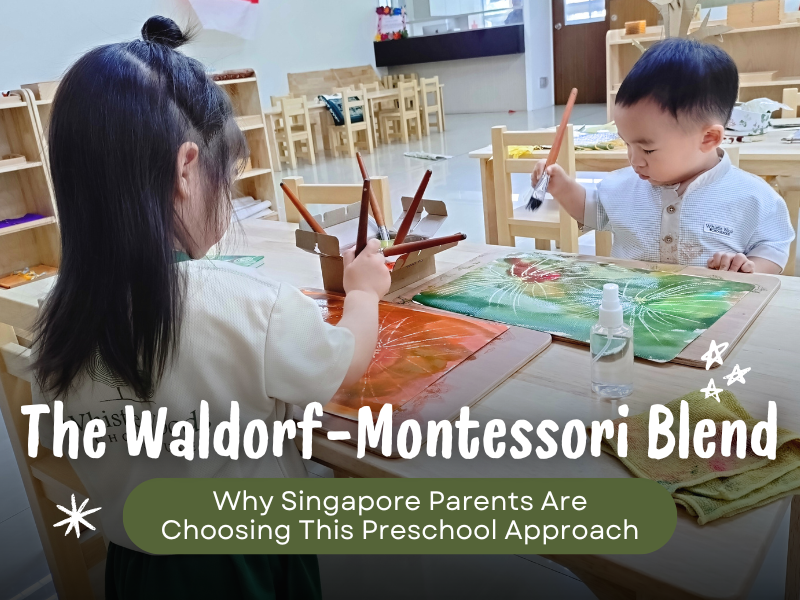
In a quiet corner, one child strings beads with full concentration. Just nearby, another hums while painting swirls of blue and yellow. Both are learning, both are absorbed, and neither is interrupted for being different.
Structure with space to breathe
Days in a Waldorf-Montessori classroom are shaped, but not crammed.
Children know what follows what. That sense of order gives comfort. But within that frame, there’s room to choose. Room to pause. Room to begin again.
A child might start their morning with handwork, then drift toward books, then sit with dough and shape it slowly. Another might sit back and watch before joining in, and that’s allowed.
This pace helps children build their own timing. They begin to sense when they’re ready, not just when they’re told.
Learning outdoors without needing to call it a lesson
In many nature-based preschool settings across Singapore, outdoor time holds as much weight as time spent inside.
Children walk barefoot on dewy grass. They carry stones. They ask about clouds. A patch of soil might turn into a café, or a puddle into a mirror. The learning emerges quietly, not through instruction, but through presence.
A child who lies on the ground to trace the outline of a leaf is not off-task. They’re just in the middle of discovering how things fit together.
Objects that do less, so children can do more
Both philosophies value simplicity in materials, and that’s intentional.
There are no flashing lights or plastic parts. No buttons that sing. The tools invite quiet action. Wool, clay, pinecones, brushes, cloth. These carry texture and weight. They invite care.
A child who carries water from one jug to another is practising more than pouring. They’re learning control, trust, awareness—all without needing to be told.
In the best classrooms shaped by this blend, you’ll find shelves with few things. But every object has a purpose.
Parents are seeking more than a syllabus
For many families, choosing a preschool goes beyond curriculum. It’s about the feeling a space gives off.
They want somewhere that doesn’t rush milestones. Somewhere that honours play, softens transitions, and welcomes different kinds of children without pressure to perform.
That’s why those searching for the top preschool in Singapore often find themselves drawn to this approach. Not because it promises early achievement. But because it holds childhood with gentleness.
Children remember how a place made them feel. So do parents.
Final thoughts
Some children jump into new spaces without hesitation. Others take a few extra days. Both are welcome here.
In our classrooms, we draw from both Montessori and Waldorf practices. We follow the child’s interest while offering gentle cues. There is structure, yes, but one that bends with the day.
Our nature-based preschool in Singapore leans on calm, sensory-rich experiences. Some days the learning begins with a question. Other days it begins with a leaf, a story, or a stretch of silence.
What matters most is that children feel at home in their learning. Not hurried, not compared, just seen.