

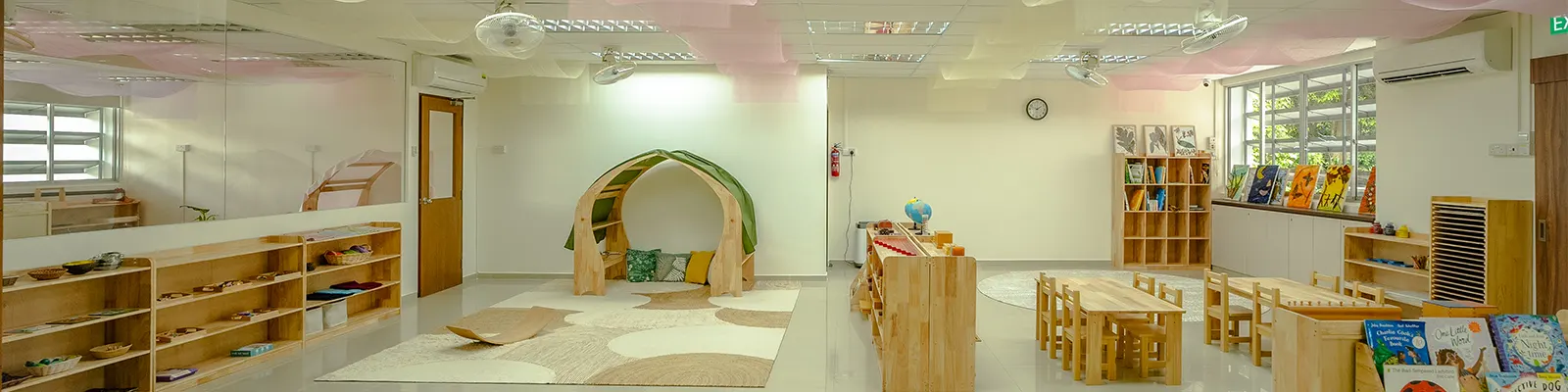
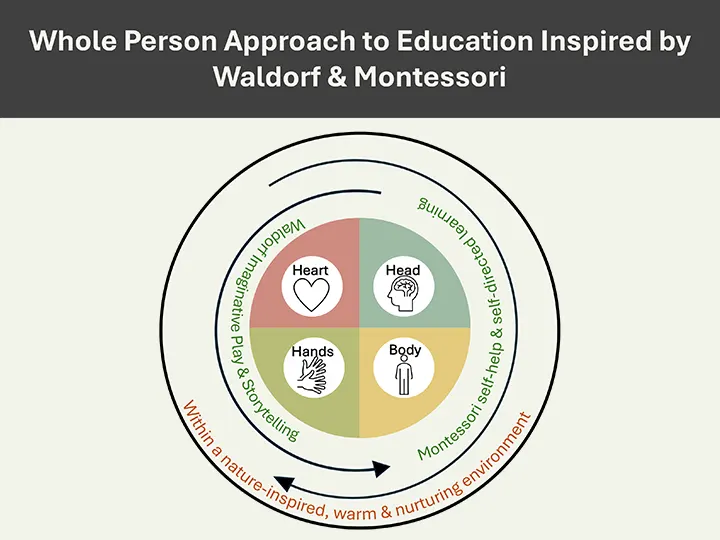
Our curriculum is primarily guided by Waldorf and Montessori educational philosophies, which is then augmented by contemporary evidence in children’s developmental psychology. As a Bukit Timah preschool, we take a “whole person” approach, focusing on the education of the head, heart, hands, and body. From Waldorf, reflected in our approach as a Waldorf preschool in Singapore, we learn to let children’s imaginations take flight and nurture them within a natural learning environment. From Montessori, as seen in our Montessori nursery in Singapore, we learn to respect children as individuals who are capable of self-help and self-directed learning. We believe that the underlying basis for younger children’s learning and growth lies in human connection and time-honoured methods of discovery such as reading, playing, and creating. This allows parents to feel assured that their children will learn and play in a warm, 100% tech-free environment.
English and Mandarin are the languages spoken and taught in our schoolhouse, making us a recommended preschool in Singapore for bilingual early learning. The children are exposed to both languages almost equally over the course of a day. Language and speech development is achieved through daily authentic conversations, poems, rhymes, music, movement and stories. And most of all, at the heart of our preschool curriculum in Singapore is a focus on nurturing a lifelong love for reading.
Group Size and Ratio
Our mixed-age group settings benefit the younger child and the older child in different ways, a practice commonly seen in Montessori preschools in Singapore. Younger ones are often impressed by what older children can do and learn by observing and imitating them. Older children are often proud to be relied on and can hone their caring and leadership skills in school, which is a key focus of our Bukit Timah preschool community.
We have two mixed-age groups in our schoolhouse, Basil for children aged 18 months to 3 years+, and Parsley for children aged 4 years to 6 years. Studies show that a low educator-to-child ratio promotes the best outcomes in the classroom, benefiting both educators’ and children’s well-being, a principle also valued by a Waldorf preschool in Singapore. Hence, the ratio for Basil is kept at 1:6, while the ratio for Parsley is 1:12.