

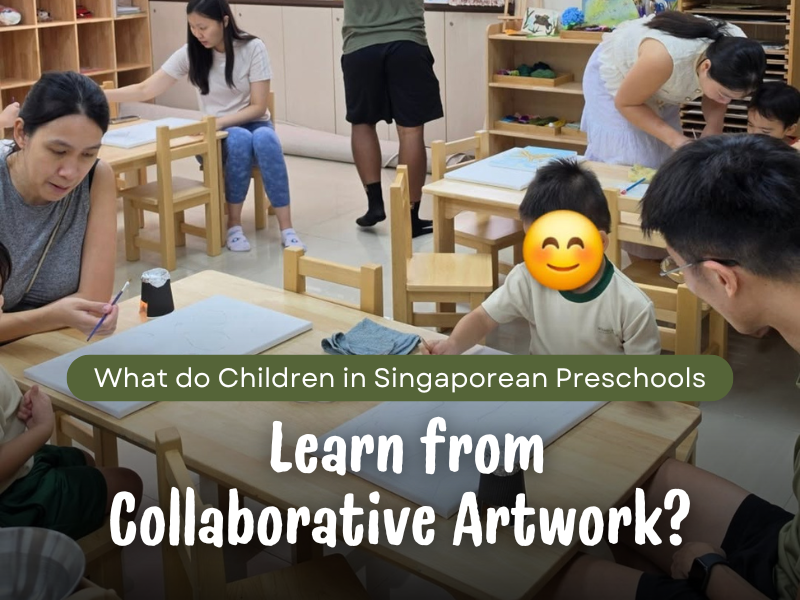
Children love art. No, they are crazy about them. Give them colours, paper, clay or craft materials. They get so excited. And when they sit down to create artwork together, something even more meaningful happens.
At Whistle Woods Schoolhouse, a top-rated child-centred preschool Bukit Timah, collaborative artwork is significant. It is not just about making something beautiful. Children learn how to share ideas. They get to know how to communicate, solve problems and appreciate one another. These valuable experiences shape them, making them grow in ways that individual activities often cannot.
Teamwork Begins with Simple Activities
Children love to use their own colours. They make their own drawings. They like to complete their own projects. It is because they are independent, naturally. Collaborative artwork builds up their team-working abilities, little by little.
It also gives educators opportunities to understand different personalities and discover how to deal with hyperactive children through engaging, hands-on group activities. The more the little hearts work together on different art projects, the more they figure out what is patience and cooperation. Through shared artwork projects, they learn valuable lessons that stay with them for long.
Builds Communication Skills
Creating artwork together needs many things. More than anything, there is a need for constant conversation.
You can see children discussing colours, shapes and ideas. They discuss where different pieces should go. Sometimes, they have different opinions. They agree at other times.
Such moments of open discussion, ideas brewing, colliding or getting in shape help them to express things clearly. The little hearts learn how to listen to other ideas thoughtfully.
The kiddos fumble less and become confident speakers. They learn to be great listeners, too. To function as a team flawlessly, communication is crucial. Then creativity follows.
Teaches Respect for Different Ideas
Imagination differs. Every child imagines things differently.
One may imagine a colourful garden. Another may picture a bright rainbow. Varied little minds function differently.
When you, as a parent, choose the best Montessori preschool in Singapore like Whistle Woods Schoolhouse, children learn faster to appreciate, rather than to compete. Perspectives differ but children pick healthy habits.
As the children combine ideas into one artwork, they jump in joy with the cumulative creative results. Approaches can be diverse, but all come together to make children understand that they belong to a group where everybody brings something unique to the table.
Encourages Problem-Solving
In group projects, things do not always go according to plan. Someone may accidentally colour over another’s work. Two children may want to paint the same section. Or the poster may not have enough space.
These shared experiences also reflect what makes a preschool feel like home, a place where children feel safe to make mistakes, solve problems, and learn together. Rather than being discouraged, children learn to think of solutions together. This process makes them sharper. Their thinking becomes more flexible. They understand that cooperation, rather than frustration, can help them to ride over challenges.
Caring About the Environment
When children engage in collaborative artwork, they use recycled paper, fabric scraps, cardboard and other natural materials.
Through these creative experiences, they learn that many everyday materials need to be thrown away. Reusing these can be fun!
This simple habit gradually develops into environmental awareness. And this lesson can stay with them, lifelong. Creative activities become more meaningful. They get opportunities to care for their surroundings, their environment.
Inspires Curiosity about Nature
Many collaborative artwork projects are inspired by trees, insects, flowers, animals and changing seasons. Nature insp
ires art; nature becomes the source of so many ideas.
As children create these artworks, they are naturally introduced to ideas related to preschool environmental education. It grows their curiosity. They observe the natural world more closely. They start asking questions – about plants, wildlife and the environment.
Art is not only just a classroom activity. It makes way for exploration and lifelong learning.
When you choose Whistle Woods Schoolhouse, a preschool near King Albert Park, collaborative artwork is not only a lesson, it is a fun way of introducing children to several other things. When you visit us, you can see how we help the little hearts to nurture creativity, engage in communication and teamwork. They slowly become aware of the environment around them – one step at a time.
Read Recent Article: Founder’s Series: Lessons from a Nine-Year-Old’s Tears