

Sharing is such a great quality but not everybody is gifted with such a big heart! Every child needs to pick such treasured qualities with time. Sometimes either you are born with it or learn with experience. Parents often try to impart this value to children via small moments in everyday life. Whether in a preschool, at a cousin’s house or while attending a friend’s birthday party – when a toy becomes a point of argument with a sibling or a friend – a child goes through a lot of emotions. Sharing is not a lesson to be taught in classrooms. It starts long before children understand social rules and the meaning of possession or belonging. In nurturing environments such as the best Montessori preschool in Singapore, children are often encouraged to develop values like sharing through meaningful everyday interactions and experiences.
And so, sharing is a value. Not only a lesson. It is much like emotional regulation or empathy. Shaped gently over time, it develops best in an environment where a child feels safe, seen and respected.
Why Sharing Does Not Come Naturally
Ownership feels personal for young children. A toy is much more than a plaything – it is a piece of their world, their identity, their preference, their comfort zone.
How can they share it? How can they part with it, even if for some time? Why should they do so?
These are the questions that boggle the little minds. When sharing is forced too early or framed as loss, children may resist or associate it with anxiety. Generosity seems a compulsion, not what the heart wants. Understanding these emotional responses is important for parents and educators, much like learning how to deal with hyperactive children requires patience, empathy, and a child-centered approach.
It helps when you do not enforce sharing as a rule to follow. Better, it should be introduced as a social skill that matures gradually – through experience, through trust.
Children Learn What They Live
Before they understand instructions, children learn behaviour by what they see. When they see adults sharing things, offering help, giving their time generously to dear ones or for a specific task, they note it down mentally. Sharing becomes less about obedience and more about connection.
This principle is often encouraged in nurturing learning environments, including a Bukit Timah preschool, where children observe and learn positive social behaviours through everyday interactions. Narrating these moments matters. A simple comment like, “I shared because it made things easier for both of us,” helps children to link generosity with positive outcomes.
Creating Security Through Turn-Taking
Fear. It is one of the biggest hurdles in the way of sharing.
What if I don’t get my toy back?
What if my brother breaks it?
What if I cannot see it again?
Parents have to reassure children that their needs still matter. They feel safe when they get back what they give, have to share for a short span, part with small things in the beginning.
When children trust that fairness exists, sharing feels less like surrender. It seems more like participation.
The Power of Being Seen
When a child shares, he gets a pat on the back for being generous!
That was kind of you. You are so nice. That’s a good boy / girl.
Children love these kinds of appreciation. Give them that, and they can recognise the impact of their action. With appreciation for every act of sharing, you can create a sense of positive reinforcement.
Over time then, sharing becomes a habit. Not something that you must teach again and again.
Practicing Sharing in Real Life
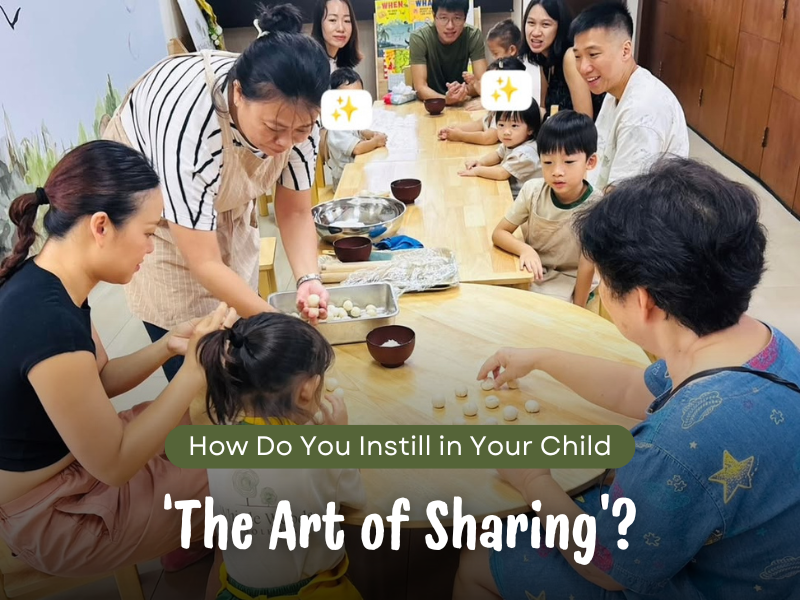
Sharing grows through lived experience. When children play collaborative games, take part in group activities or have family meals, they can get ample chances to show their generosity. It never feels forced. They understand instinctively that they have to do it. Or risk being labelled as a miser.
Creating such meaningful learning opportunities is one of the reasons why parents are choosing boutique preschools, where children are encouraged to develop important social and emotional skills through everyday experiences. These moments quietly teach children that sharing creates joy beyond themselves.
Empathy at the Core
Teaching empathy and sharing does not happen in a day. These are values formed with habit, with care and with patience. Whistle Woods Schoolhouse believes in inculcating lovable social behaviour every day, making children understand that “Sharing is Caring”.
Visit us today. Experience it first-hand for your little one.